Get the Facts
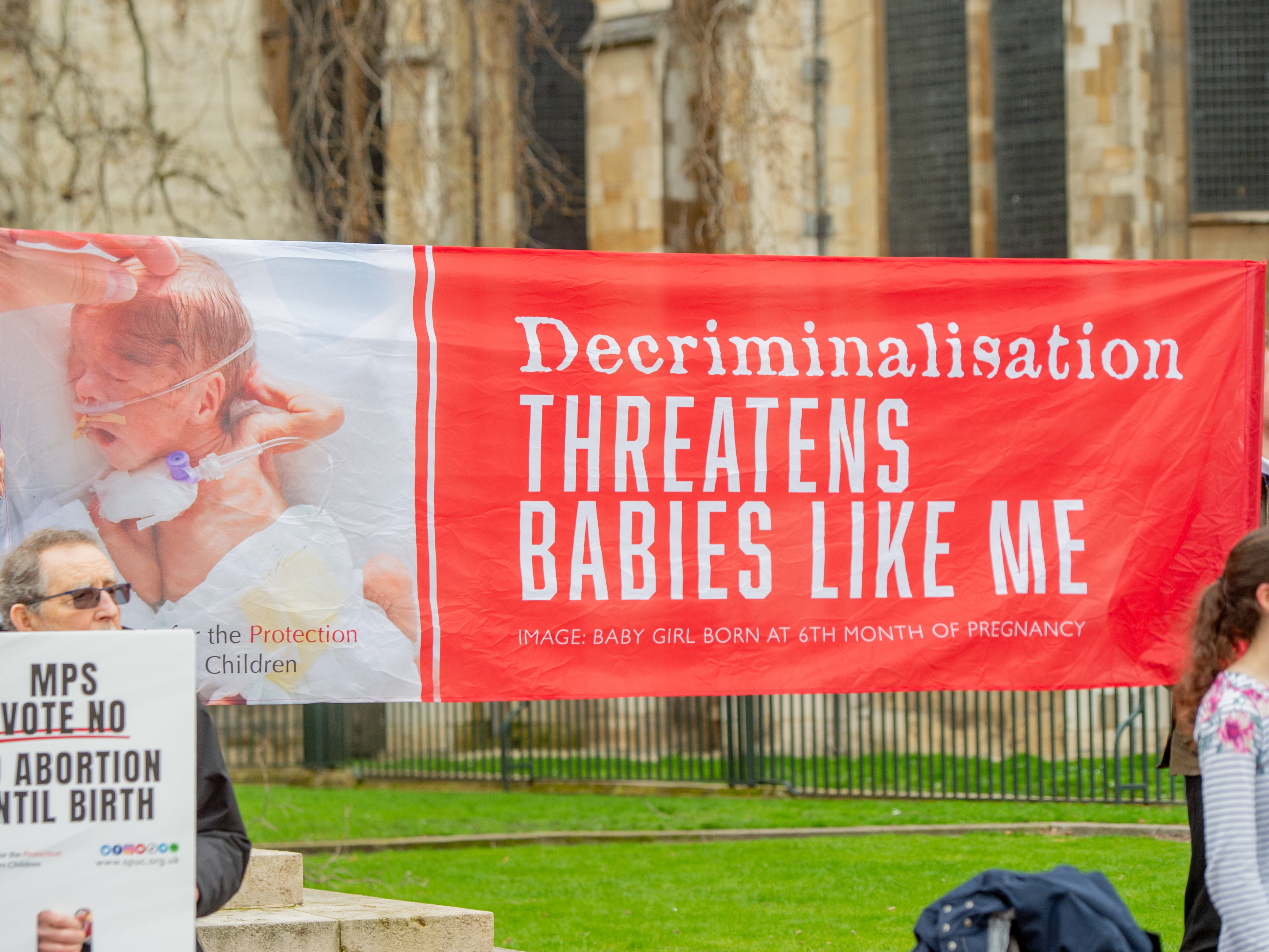
Parliament recently approved an amendment to the Crime and Policing Bill, so that, for the purposes of existing abortion law, “no offence is committed by a woman acting in relation to her own pregnancy”.
There have been many attempts in the media and by abortion providers to “debunk” the “misinformation” by pro-life groups that this change legalises abortion up to birth.
On this page you will find an explanation of exactly what decriminalisation does and its implications for women and unborn babies.
-
What happened in Parliament?
On Tuesday 17 June 2025, MPs debated New Clause 1, tabled by Tonia Antoniazzi MP, to the Government’s Crime and Policing Bill. After less than two hours debate, MPs approved the proposal by 379 votes to 137. This clause was thus part of the Crime and Policing Bill when it was passed to the House of Lords.
Abortion decriminalisation was debated several times as the Bill moved through the Lords. On 18th March 2026, Baroness Monckton of Dallington Forest moved an amendment to remove the clause from the Bill. This was defeated by 185 votes to 148.
Several other amendments relating to abortion were also debated and voted on. One tabled by Baroness Stroud, to return to mandatory in person appointments before abortion drugs are dispensed to women, was defeated by 191 votes to 119. The only amendment passed by the Lords was one tabled by Baroness Thornton, on pardoning women who have been convicted of abortion related crimes in the past. This passed by 180 votes to 58. The Bill received Royal Assent and passed into law on 29 April 2026.
-
What does the decriminalisation Clause actually say?
The wording of the Clause is:
“Removal of women from the criminal law related to abortion
For the purposes of sections 58 and 59 of the Offences Against the Person Act 1861 and the Infant Life (Preservation) Act 1929, no offence is committed by a woman acting in relation to her own pregnancy.”
The explanatory statement given by Tonia Antoniazzi MP was:
“This new clause would disapply existing criminal law related to abortion from women acting in relation to their own pregnancy at any gestation, removing the threat of investigation, arrest, prosecution, or imprisonment. It would not change any law regarding the provision of abortion services within a healthcare setting, including but not limited to the time limit, telemedicine, the grounds for abortion, or the requirement for two doctors’ approval.”
-
What is the “existing criminal law”?
The sections of the Offences Against the Person Act 1861 (OAPA) and Infant Life (Preservation) Act 1929 (ILPA) referred to here form the legal underpinning of the current abortion law. The 1967 Abortion Act did not repeal these laws that criminalised abortion – it set out exceptions when doctors could lawfully perform abortions within this framework.
-
So what does disapplying these laws from women mean?
Disapplying these offences for women in relation to her own pregnancy therefore removes any legal restrictions on women regarding her own abortion. This is a sweeping change – there is now no law under which a woman can be prosecuted for aborting her own pregnancy.
-
Does this really mean abortion up to birth?
Again, there is now no law under which to prosecute a woman who aborts her own pregnancy. This applies whatever her reason is, and whatever stage of pregnancy.
The explanatory statement given by Tonia Antoniazzi MP is explicit that this applies to a “pregnancy at any gestation”. This, therefore, does legalise abortion up to birth, when it is induced by the woman herself.
This was clearly intentional, not an unintended consequence. In an interview with Times Radio on 10 June 2025, Ms Antoniazzi was asked: “Any woman could end a pregnancy at any time, 35 weeks, 36 weeks, 37 weeks, without committing an offence. And you are comfortable with that?” to which she replied “Yes I am” (https://x.com/TimesRadio/status/1932364290549325939).
-
But I’ve heard that the 24-week limit hasn’t changed?
The 24-week limit for Ground C abortions (the ground under which the vast majority of abortions occur) has not been removed from the 1967 Abortion Act. It still applies for clinicians signing off on an abortion in a medical setting. But the underlying law on which the 1967 Act depends has now been disapplied to women, rendering it null. To repeat, women now cannot be prosecuted at all, ever, in relation to her own pregnancy, at any gestation, which includes after 24 weeks. Abortion up to the point of birth is now legal when induced by the woman herself.
-
So, a woman can induce her own abortion up to birth, but couldn’t get one that late in a clinic?
Yes. We can be sure that the abortion lobby will soon attempt to correct such an illogical situation, and campaign for full decriminalisation of abortion, to allow abortion up to birth in a medical setting.
-
But isn’t this just stopping women who carry out late-term abortions being prosecuted, not making those abortions legal?
No. This change doesn’t just stop prosecutions, it disapplies the very law that made such abortions illegal. It is a fundamental principle of English law that unless something is specifically prohibited by law, then it is legal. There is now no law prohibiting a woman carrying out her own abortion up to birth, therefore it is legal.
-
Will women really self-induce abortions up to birth though?
That is a different question than whether it is legal to do so. But yes, such cases have already happened – and were what sparked this change in the law. In one such case, Carla Foster, a mother from Staffordshire, was sentenced to imprisonment after it was found that she lied to abortion provider BPAS to obtain abortion drugs well past the legal limit for abortion (https://www.judiciary.uk/wp-content/uploads/2023/06/R-v.-Foster-sentencing-remarks-12.6.23.pdf). Her daughter Lily was born dead at 32-34 weeks’ gestation.
-
How did she obtain the drugs?
Carla Foster was able to obtain the drugs because of the pills-by-post policy, whereby consent is given for abortion over the phone, and the drugs sent in the post. This scheme was introduced during the COVID pandemic and made permanent in 2022.
While there are no definitive figures for the number of pills-by-post abortions, taking both medications at home is the most common procedure, accounting for 72% (200,745 out of 277,970) of abortions in 2023 (the last year statistics are available) (https://redlionchambers.co.uk/rare-poisoning-trial-ends-with-unanimous-convictions/).
There have been several cases besides hers of women obtaining drugs for self-induced abortion after the limit for these pills (ten weeks gestation) and even after the 24-week limit, by abusing this scheme.
Self-induced abortion is now how most abortions occur, and the removal of the legal deterrent is likely to lead to more cases of it being done later in pregnancy.