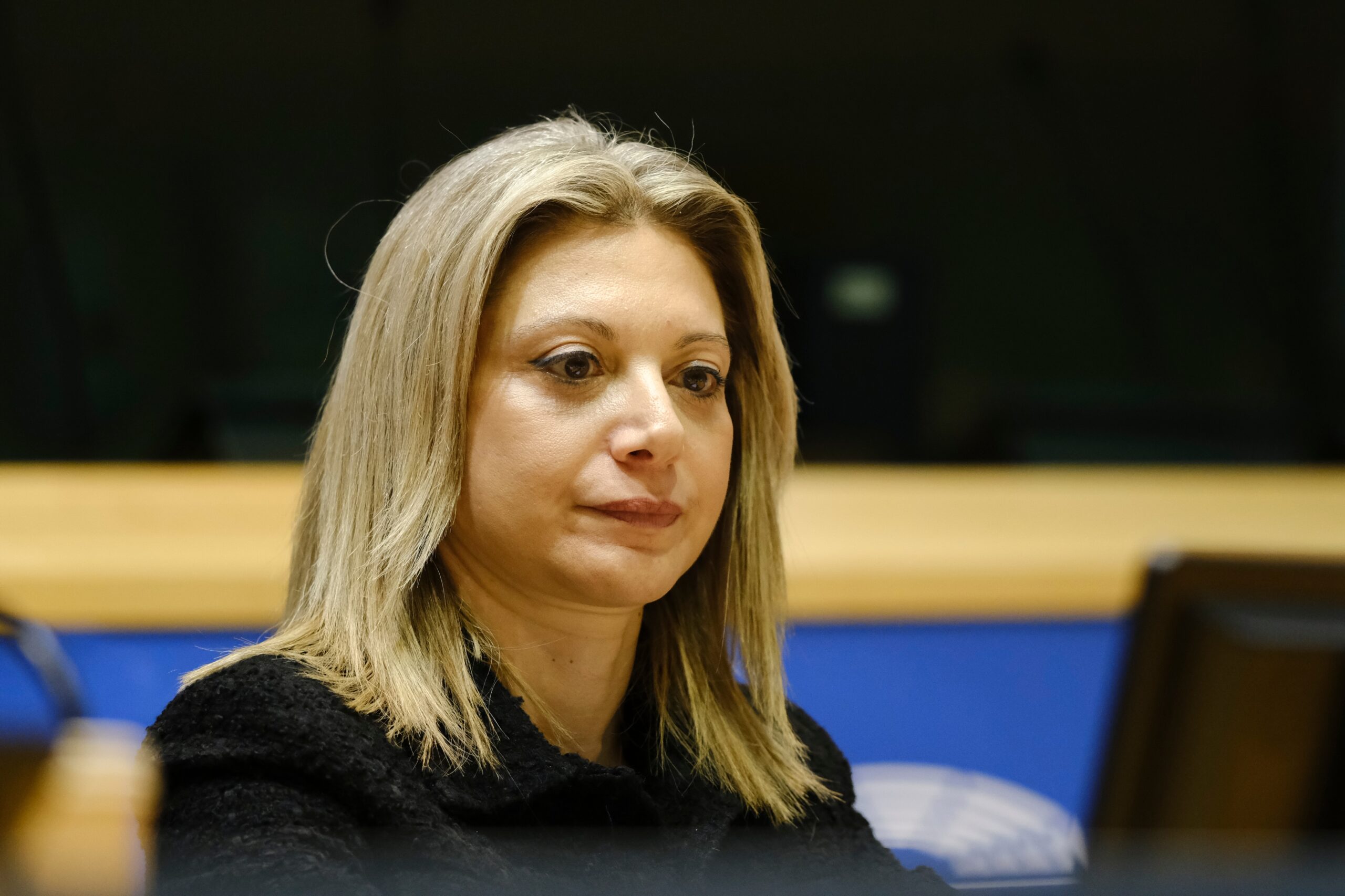
Image – Shutterstock: Maria Karystianou speaking at the European Parliament in 2024
The abortion debate in Greece, long regarded by the political establishment as settled and closed, has been unexpectedly reopened by a figure whose growing political significance has unsettled the entire system. Maria Karystianou, a paediatrician who rose to national prominence after losing her daughter in the 2023 Tempi train disaster and who is now widely expected to launch a new political party, has triggered fierce controversy after calling for public consultation on abortion.
Karystianou’s remarks, made during a televised interview, were cautious but unmistakable. She said that while she respects women’s free will, abortion raises ethical questions that extend beyond individual choice. Drawing on her medical background, she argued that the issue involves not only women’s rights but also the rights of the unborn child. Referring to foetal development, she said that from the point at which a heartbeat begins, life should be recognised as having been created, and that such questions merit wider democratic discussion.
The reaction was immediate and hostile. Government spokesmen and opposition figures alike insisted that abortion in Greece was “settled” decades ago and accused Karystianou of advancing dangerous and extreme-right positions.
Yet the intensity of the backlash highlights how fragile that supposed consensus may be. Abortion was legalised in Greece in 1986 under Law 1609, during a PASOK government led by Andreas Papandreou. The law amended the Criminal Code to permit abortion on request up to twelve weeks, and later in pregnancy under defined conditions, including foetal anomaly, risk to the woman’s health, or pregnancies resulting from rape or incest. The state also assumed responsibility for ensuring women’s access to abortion facilities.
At the time, the legislation was the product of fierce parliamentary debate and deep cultural division. Health Minister Georgios Gennimatas and other PASOK figures argued that legalisation was necessary to protect women from unsafe, illegal abortions and to end what they described as a hypocritical system. New Democracy MPs opposed the bill, warning that it undermined the sanctity of life and permitted the termination of human existence at the embryonic stage. The Orthodox Church mounted strong resistance, condemning the proposal and urging its withdrawal.
Parliamentary debates in 1986 were often heated, occasionally chaotic, and sometimes openly moral in tone. Yet out of that conflict emerged a legal settlement that has endured for nearly four decades.
This is what makes Karystianou’s intervention so significant. She has not denied the existence of the law, nor called for its immediate repeal. Instead, she has challenged the assumption that legislation alone resolves ethical questions, particularly when they concern life, responsibility, and human dignity. Coming from a figure who has already mobilised mass protest and who may yet command substantial electoral support, her words carry far greater weight than those of a marginal commentator.
Whether or not Karystianou ultimately enjoys electoral success, the reaction to her remarks reveals a deeper unease within Greek public life. The insistence that abortion is beyond discussion sits uneasily with a society grappling with distrust, grief, and a demand for moral seriousness from its leaders. In that sense, the reopening of the abortion debate is not an aberration, but a sign of a political culture being forced to confront questions it has long tried to silence.
SPUC’s Communications Manager, Peter Kearney, says, “I hope that simply the mention of the rights of the unborn child by Maria Karystianou will get the minds of the Greek people and politicians thinking about what it is they have settled for over the last forty years, and that her boldness will be part of the undoing of a culture of death all around Europe.”
If you’re reading this and haven’t yet donated to SPUC, please consider helping now. Thank You!