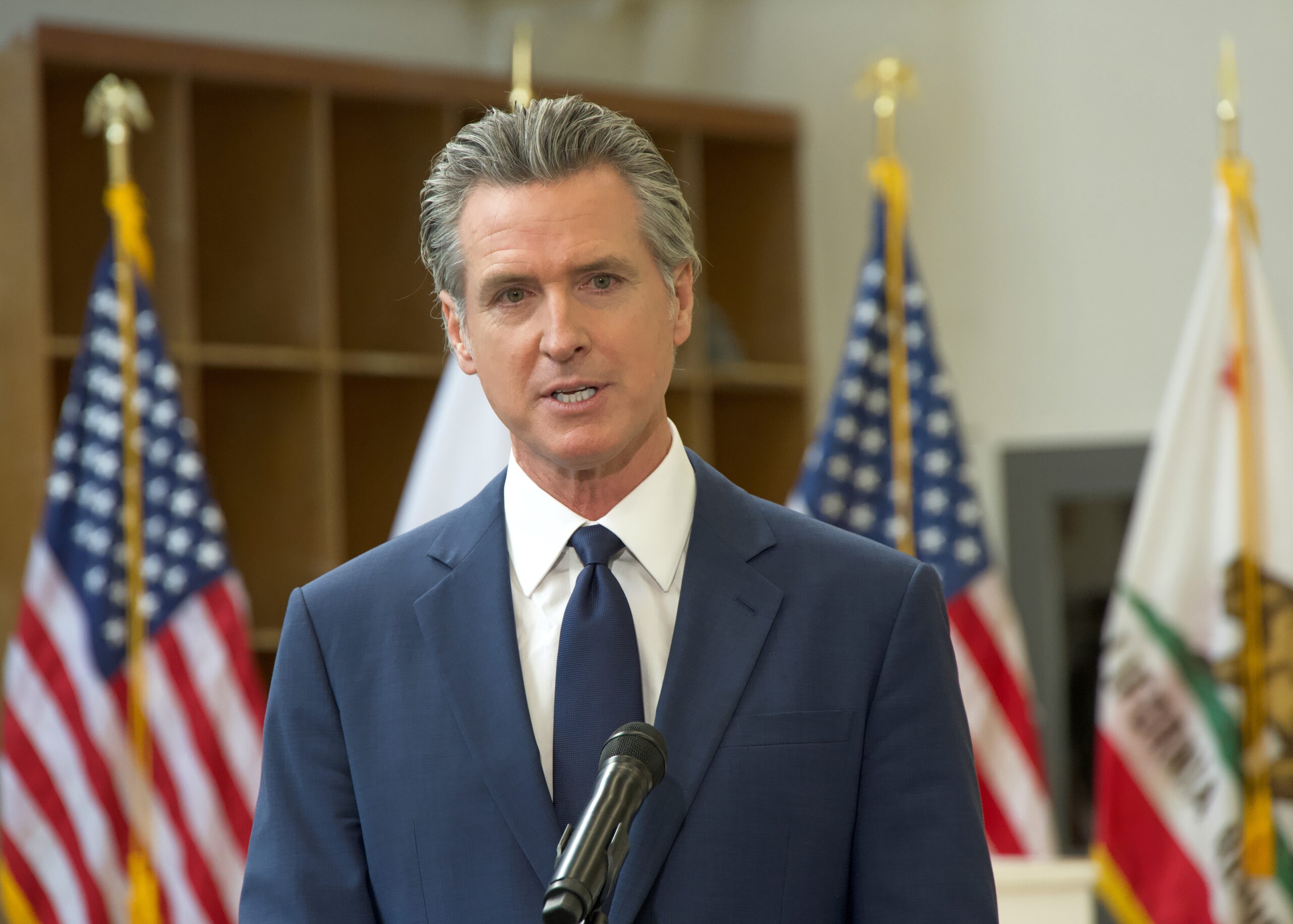
Image – Shutterstock: Gavin Newsom speaking at a press conference in 2025
California Governor Gavin Newsom has revealed that he sat beside his mother as she died by assisted suicide, describing the experience as “horrible” and admitting he “hated her for it” for years afterwards.
The story appears in Newsom’s forthcoming memoir, Young Man in a Hurry, and is likely to reignite debate about assisted suicide in the United States where Newsom is seen as the favourite Democratic presidential contender in 2028.
In an interview, he recalled receiving a voicemail from his mother, Tessa, in 2002. She told him that if he wanted to see her again, he would need to do so before the following Thursday, when she planned to end her life. She was 55 and dying of cancer.
Newsom said he did not try to dissuade her. On the day itself, he and his sister sat by her bedside. His sister later left the room, but Newsom stayed. He described lying with his head on her stomach after her death, waiting for another breath.
Yet while Newsom frames the experience as evidence for expanding assisted suicide, his account points to a darker reality: assisted suicide does not merely end a life, it leaves families with moral trauma, unresolved grief, and deep psychological scars.
Newsom admitted that he lived with anger for years, not simply because his mother died, but because she asked him to be present for it. That is a telling detail, because it reveals a truth campaigners often avoid. Assisted suicide is rarely a purely private act. It becomes an event that pulls others in, forcing relatives into complicity, whether they want it or not.
Despite his emotional turmoil, Newsom has been one of the key figures responsible for expanding assisted suicide in California. Since the state legalised the practice in 2015, he has signed legislation reducing the waiting period from 15 days to 48 hours and removing other safeguards.
His memoir may be intended to humanise his politics. Instead, it exposes the grim reality behind the slogans. Assisted suicide does not just end suffering. It can create a new kind of suffering, for the dying person, for relatives, and for society, which quietly learns that death is an acceptable solution to pain.
Commenting on the story, Peter Kearney, the Communications Manager of SPUC, said, “No matter his intention, Gavin Newsom has shown a raw truth about assisted suicide. It is cold, harsh, and affects more than just the dying person. Families are left with trauma, especially when the process is done as quickly as it was in this case – it completely alters the grieving process. SPUC continues to work to make sure this does not become a reality in the United Kingdom, fighting against the faux compassionate option, and instead calling for effective care to comfort those at the end of life. Evidently, Newsom’s story is not a triumph, but a warning.”
If you’re reading this and haven’t yet donated to SPUC, please consider helping now. Thank You!