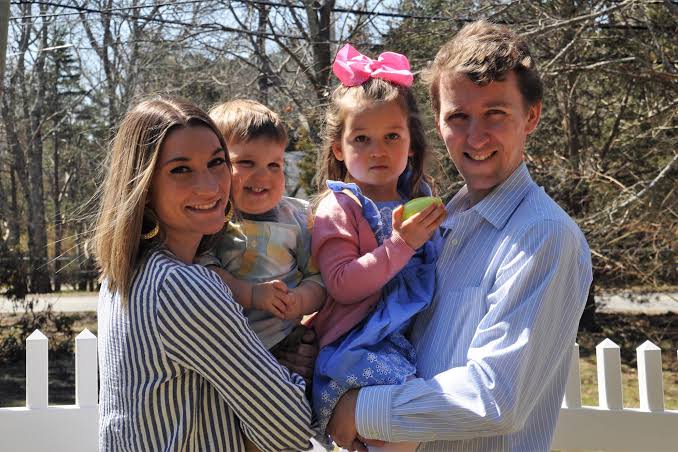
Image: Lindsay Marie Clancy Facebook
Lindsay Clancy, a 36-year-old Massachusetts mother and former labour and delivery nurse, is standing trial for the murder of her three young children, whom she strangled with exercise bands at their family home in Duxbury on 24th January 2023. Clancy has not denied killing the children, but has pleaded not guilty, with her defence arguing that postpartum psychosis meant she was not criminally responsible. Prosecutors dispute that account and argue that Clancy deliberately killed the children after arranging for her then-husband, Patrick, to leave the house to collect food and medicine.
Sadly, the trial has become about far more than the question of whether Clancy was legally responsible for killing her children. It has provoked an extraordinary cultural reaction in which hundreds of women have rallied behind Clancy, while social media has filled with mothers identifying their own frustrations with hers.
Outside Plymouth Superior Court last week, hundreds of women dressed in pink gathered in support of Clancy. Supporters claim they are not endorsing the killing of children but drawing attention to postpartum mental illness and what they consider inadequate support for mothers.
Online, however, the response has become considerably stranger—if such a thing was possible. Women have posted emotional videos identifying with Clancy and expressing their anger and exhaustion with motherhood. Viral videos have included mothers throwing ice into baths and striking or slamming objects as supposedly safer ways of releasing the rage they harbour towards their children.
A new trend? Let’s throw ice at your bathtub so you don’t hurt your kid pic.twitter.com/5jQSp7D58l
— Luka (@LukaLev) August 19, 2026
The children risk becoming supporting characters in the story of the woman who killed them. As commentator and mother-of-six Bethany Mandel observed of the demonstrations: “We all know her name,” while comparatively few people know the names of Cora, Dawson, and Callan.
An opposing interpretation has presented the case primarily as an indictment of America’s treatment of mothers.
Postpartum depression is real, serious, and deserving of compassionate treatment. Postpartum psychosis is rarer and can constitute a psychiatric emergency. Recognising those realities, however, need not require society to make the perpetrator the emotional centre of a case in which three children were killed.
Mental illness can be profoundly relevant to culpability, but psychological disturbance cannot become an automatic explanation that ends every moral discussion about horrific acts. People capable of terrible crimes are frequently profoundly disturbed. We as a society risk becoming one that ceases to prosecute the most heinous crimes when we elevate sympathy with the mentally ill over the sympathy of victims. Does an illness really deprive people of the capacity required for criminal responsibility?
For pro-lifers, there is also an uncomfortable cultural continuity. Western society has spent decades insisting that motherhood is subordinate to adult choice and that a child’s dependence upon his or her mother can make that child’s continued existence negotiable before birth. Massachusetts itself recently expanded its abortion law dramatically. If we follow that to its logical endpoint, what is wrong with Clancy’s crime? Abortion and the killing of born children are legally distinct acts, but analogous in the minds of pro-lifers and now, seemingly, progressive women.
Increasingly depicting motherhood as an imposition from which women must be liberated ends at this point.
Children have needs that adults have obligations to meet precisely because children are innocent, dependent, and vulnerable.
SPUC CEO John Deighan commented, saying: “Lindsay Clancy has killed her children in cold blood. Cora, Dawson, and Callan deserve justice. They were not symbols of the burdens of motherhood, but three children whose lives deserved protection.”
He continued, “Why are we shocked at this reaction? We see women celebrating abortion up-to-birth and rallying to protect people who have been charged with horrendous crimes against the unborn. What makes this different? The hedonism of modern society has reached its end point: the vulnerable seen as a burden simply because they require something of the capable. The fight for children can only be won with deep cultural renewal that promotes responsibility over self.”